When the Oil Stops: What the Iran War Reveals About the World We Built
A war in the Persian Gulf isn't just a geopolitical story. It is a mirror held up to the architecture of modern civilization — and what it reflects should change how every thinking person lives.
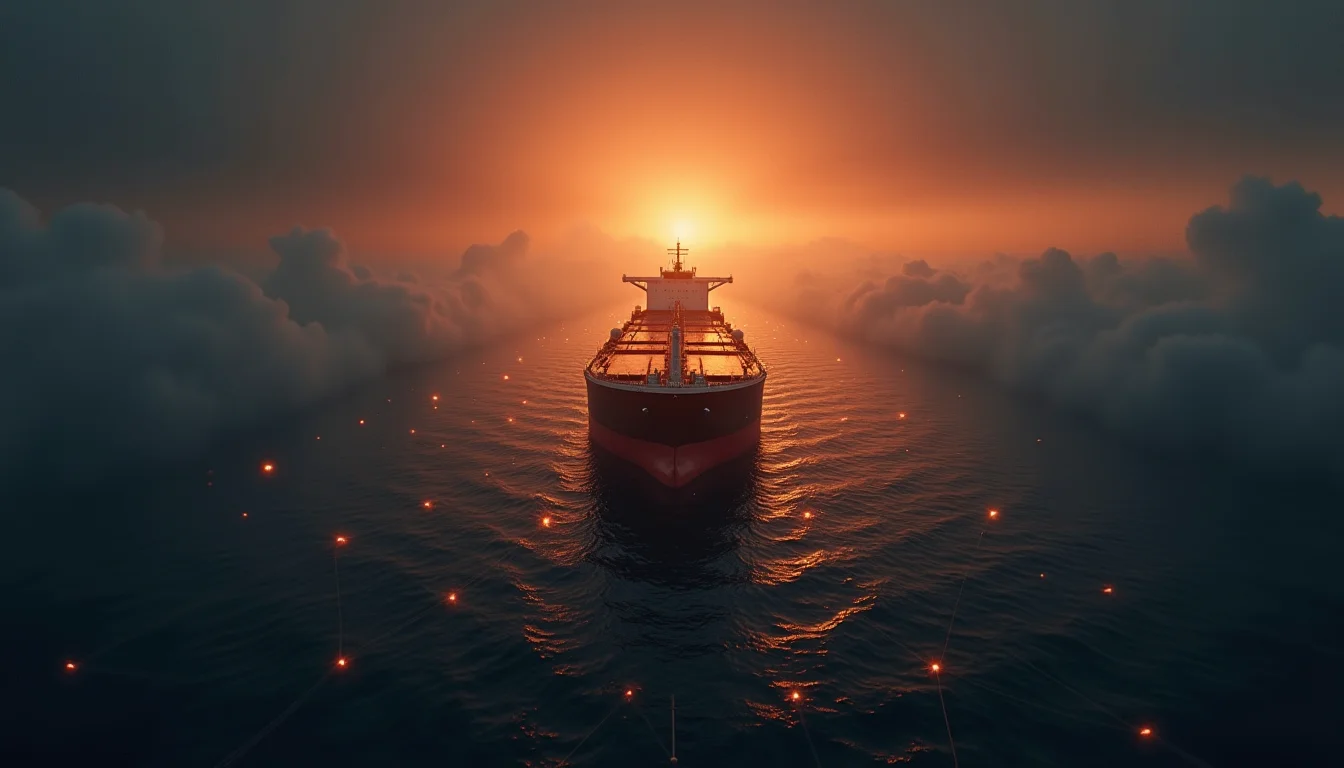
On February 28, 2026, the United States and Israel launched a military campaign against Iran. Within hours, 150 oil tankers were stalled in the Persian Gulf. Shipping through the Strait of Hormuz — a narrow waterway no wider than 21 miles at its tightest point — slowed to a standstill. The International Energy Agency called it “the greatest global energy security challenge in history.” Japan scrambled. The Philippines declared a national energy emergency. Pakistan ordered a four-day work week. California gasoline hit $5 a gallon.
The world had its answer to a question it never thought to ask: what happens when a single chokepoint fails?
This article is not about the politics of who is right or wrong in this war. It is about something deeper — the systems architecture of modern civilization, and what this moment reveals about how profoundly fragile it truly is.
The Strait That Runs the World
The Strait of Hormuz is 21 miles wide at its narrowest. Through it flows roughly 20% of the world’s entire oil supply — approximately 21 million barrels per day. It is the jugular vein of the global economy. There is no meaningful alternative route. No shortcut. No bypass. The Suez Canal cannot absorb it. The pipelines around the Arabian Peninsula carry only a fraction.
In systems thinking, we call this a single point of failure — a node whose removal causes the entire system to collapse. The Strait of Hormuz is perhaps the most dangerous single point of failure on the planet, and the 2026 Iran war has made that visible to anyone paying attention.
Goldman Sachs has already warned: if the Strait remains closed for weeks, oil crosses $100 per barrel, inflation becomes structural, and the global economy enters a period of synchronized contraction. These are not fringe predictions. These are mainstream financial institutions reading the architecture of a world built almost entirely on petroleum.
Oil Is Not Just Fuel. It Is the Substrate of Civilization.
Here is where most people’s understanding fails. They think of oil as gasoline — the thing that moves their car. But petroleum is not primarily a fuel. It is a raw material for the physical structure of modern life.
Consider what is made from petroleum: plastics of every kind, synthetic rubber, asphalt for every road, the polyester in your clothing, the fertilizers that grow your food, the pesticides that protect it, the packaging that ships it, the lubricants in every machine, the chemicals in most pharmaceuticals, the foam in your mattress, the casing of your phone. Remove petroleum and you do not just lose transportation. You lose the material infrastructure of everything.
“Oil and gas are not just fuel. They are raw materials for thousands of products, including the fertilizers used in farming.” — Al Jazeera, March 2026
When the Strait of Hormuz is threatened, the price of oil rises. When the price of oil rises, everything rises — because petroleum is embedded in the cost of producing, packaging, transporting, and refrigerating virtually all food and goods. The inflation you feel at the grocery store is not separate from the war in Iran. It is the same system expressing the same pressure through a different node.
This is what systems thinkers call propagation: a disruption at one point cascades through interconnected nodes, amplifying at each step, until the original shock is nearly unrecognizable in its downstream effects.
Centralization Is the Fragility
For decades, globalization was sold as efficiency. And it is efficient — in the way that a monoculture farm is efficient. Plant one crop across ten thousand acres and you maximize yield per unit of labor. Until a single pathogen arrives. Then you lose everything, everywhere, at once.
The global petroleum system is a monoculture. It is maximally efficient under stable conditions and maximally fragile under stress. A single waterway — 21 miles wide — controls the energy diet of half the planet. A single conflict can starve Japan, paralyze Pakistan, and send California gas prices above $5.
“The architecture of modern civilization optimized for efficiency. It forgot to optimize for resilience.”
This is not a new problem. It is the fundamental design flaw of centralized systems, revealed again and again throughout history. The Roman grain supply. The British coal dependency. The American oil addiction. Each era builds a civilization on top of a single, concentrated resource stream — and each era eventually discovers the catastrophic cost of that concentration when the stream is interrupted.
What is new in 2026 is the scale. The interdependency is now global and total. There is no region that is untouched. There is no economy that is insulated. The efficiency of globalization has created a system where every nation’s survival is linked to the same narrow passages of geography and politics.
The Sovereignty Imperative
I want to be careful here, because this is where the analysis can veer into panic or tribalism. Neither serves clear thinking.
The lesson of the Iran war is not that you should hoard fuel or prepare for collapse. The lesson is far more fundamental: sovereignty — at every scale — is the intelligent response to centralized fragility.
Sovereignty means owning the means of your own survival at the level at which you operate. A nation that produces its own food, generates its own energy, and manufactures its own essentials is not immune to global disruption — but it is resilient in ways that dependent nations are not. A community with local food systems, water independence, and distributed energy is not cut off from the world — but it does not collapse when the supply chain breaks.
And at the level of the individual and the household? The same principle applies.
- Energy sovereignty — Solar panels, battery storage, and decentralized grids are not just environmental preferences. They are structural resilience against oil-price shocks.
- Food sovereignty — A garden, a local farm relationship, or even a well-stocked pantry represents a meaningful degree of independence from petroleum-dependent supply chains.
- Financial sovereignty — Hard assets — land, precious metals, decentralized digital currencies — are hedges against the inflation that follows every oil shock. The 1973 oil crisis proved this. 2026 is proving it again.
- Knowledge sovereignty — Understanding how systems actually work — not how they are presented — is perhaps the most valuable form of sovereignty. You cannot navigate a crisis you have not modeled.
This Changes Everything — If We Let It
Every major civilizational inflection point arrives disguised as a crisis. The 1973 oil shock should have launched a renewable energy revolution. It didn’t — because the crisis was resolved just quickly enough for inertia to reassert itself. The 2008 financial collapse should have restructured the global banking system. It didn’t — because the bailouts arrived just in time to preserve the existing order.
The 2026 Iran war is another such moment. And like those before it, the question is not whether the crisis is real. It clearly is. The question is whether the disruption will be severe enough — and last long enough — to break the inertia that keeps civilization orbiting the same petroleum sun.
I believe this time is different. Not because the crisis is uniquely severe — though it may be — but because of what has changed around it. Renewable energy is now cost-competitive with fossil fuels in most markets. Decentralized technologies — from solar microgrids to blockchain-based financial systems — are mature enough to deploy at scale. The awareness of systemic fragility, accelerated by COVID, by inflation, by supply chain disruptions, has reached a critical mass in the public consciousness.
The Iran war has not created this awareness. It has focused it.
The question for any thinking person is not whether the old system is breaking. It clearly is. The question is what you are building to replace it — in your own life, your own community, and your own mind.
What a Systems Thinker Does Now
Watch the negotiations carefully. As of this writing — Day 25 of the war — Trump has postponed strikes on Iranian power plants for five days, claiming productive talks. Iran denies any talks occurred. The Strait remains effectively closed. Goldman Sachs and the IEA are both watching the same threshold: if it stays closed past 30 days, the economic damage becomes structural rather than temporary.
But do not be lulled into passivity by the prospect of de-escalation. Whether this particular conflict resolves or escalates, the underlying architecture has not changed. The Strait of Hormuz will remain 21 miles wide. The world’s dependence on it will remain. The next crisis — whether it comes from Iran, from a tanker accident, from a cyberattack on refinery infrastructure, or from the next geopolitical rupture — will find the same vulnerabilities.
The intelligent response is not anxiety. It is architecture. Build your life — your finances, your food, your energy, your community — with resilience as a design principle, not an afterthought.
The era of abundant, cheap, centralized petroleum was a historical anomaly. It lasted roughly 100 years. It is ending — not with a single event, but through a series of escalating disruptions that each reveal how thin the margin truly is.
What comes next is not necessarily worse. It could, in fact, be far better — more distributed, more local, more resilient, more human in scale. But that future is not automatic. It is built, intentionally, by people who understand the system well enough to see past it.
The war in Iran is a systems event. Its consequences will ripple through food prices, inflation, geopolitics, and energy policy for years to come. The question it poses to every thoughtful person is simple: are you a passenger in this system, or are you actively building sovereignty outside of it?
The answer to that question may be the most important decision of the decade.
William Le, PA-C is a physician assistant, functional medicine practitioner, and founder of Gaia Functional Wellness in Miami. He writes at williamle.net on sovereignty, systems thinking, and the intersection of ancient wisdom with modern complexity.