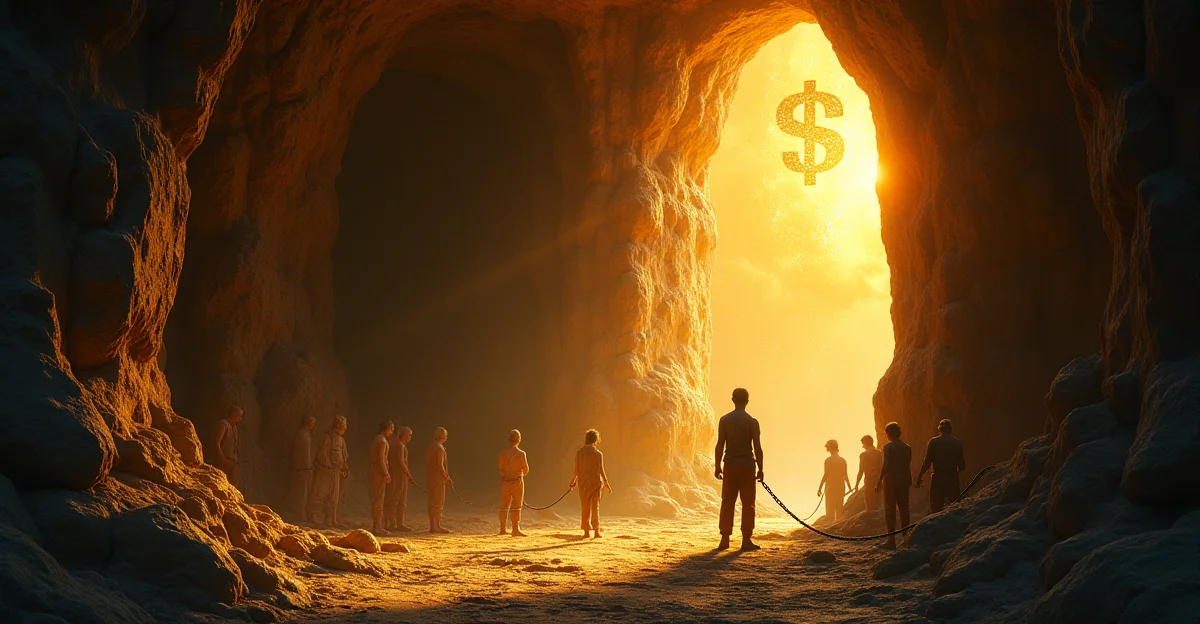
The Cave Is the Economy: Plato, the Petrodollar, and the War You're Not Supposed to See
The US-Iran war isn't geopolitics. It's the finance tier trying to force the resource tier back into submission. Plato saw it 2,400 years ago. Here's the architecture of the illusion — and the exit.
A YouTuber named Crypto Casey recently published a video that, beneath its crypto-influencer packaging, contains one of the clearest structural analyses of global power I’ve encountered in popular media. The core framework comes from Professor Jeng Xiwin, but Casey’s synthesis deserves attention — not because it’s new, but because it names the architecture plainly.
The argument: the US-Iran conflict is not primarily about religion, regional politics, or defending democracy. It is the finance tier of the global economy attempting to force the resource tier back into submission before the dollar-based illusion collapses.
That sentence will sound conspiratorial to some. Let me unpack why it isn’t.
The Game Board
The global economy is structured in tiers. This is not opinion — it’s observable:
| Tier | Function | Nations |
|---|---|---|
| Resources | Raw materials, energy | Russia, GCC (Saudi Arabia, UAE, Qatar, Kuwait, Bahrain, Oman), Iran |
| Manufacturing | Production, assembly | China |
| Knowledge | Services, IP, tech | EU nations, Canada, Australia, New Zealand |
| Finance | Rule-making, currency control | United States |
The game master sits at the finance tier. Not because Americans are inherently more powerful, but because the game was designed so that global energy — the foundational resource — must be traded in US dollars. This is the petrodollar system, established in the 1970s. It creates artificial demand for dollars, which allows the United States to print currency without immediately destroying its own economy.
Everything flows from this single structural fact.
When the US has a problem with a country, it doesn’t need to invade. It simply prevents that country from playing the game. It cuts them off from SWIFT — the nervous system of international payments. It happened to Iran in 2012, 2018, and 2026. It happened to Russia in 2022. The message is always the same: obey, or your wealth gets turned off.
The Cave
Casey uses Plato’s allegory of the cave — and it’s not decoration. It’s structurally precise.
In Plato’s story, prisoners are chained from birth in a cave, facing a wall. Behind them, people they can’t see use puppets and fire to cast shadows on the wall. The shadows are all the prisoners have ever known. They name the shadows. They develop language around them. They build an entire reality from projections someone else controls.
The shadows in our cave are cast through three mechanisms:
Education. The public system was not designed to produce sovereign thinkers. It was designed to produce compliant workers who don’t ask structural questions. No courses on monetary policy. No classes on how the Federal Reserve actually works. University costs that put people into six-figure debt before their first job — debt that cannot be discharged in bankruptcy. This is not accidental. A financially illiterate population is easier to extract from.
Media. CNN, BBC, the New York Times, TikTok — these are not information systems. They are projection systems. They don’t tell you what is happening. They tell you what to think about what is happening. The framing is always provided. The structural analysis is always missing.
Culture. Hollywood, Netflix, streaming platforms — they serve the same function as the Roman circus. Distraction. Division. Materialism as identity. Keep people consuming, competing, and afraid, and they will never look behind them to see who is casting the shadows.
This is not conspiracy theory. It’s systems analysis. The question is not whether these mechanisms exist — anyone paying attention can see them. The question is whether they are coordinated or emergent. And the honest answer is: it doesn’t matter. The effect is identical.
Why Iran, Why Now
Iran sits on the fourth-largest proven oil reserves on Earth. It borders the Strait of Hormuz, through which 20% of the world’s oil supply flows daily. Iran is a resource-tier nation with enormous leverage — and it just joined BRICS.
In January 2024, the BRICS alliance expanded to include Iran, Saudi Arabia, and the UAE. Today, BRICS nations control over 40% of global crude oil production and represent nearly half the world’s population. They are actively:
- Trading in local currencies instead of dollars
- Building alternative payment networks to bypass SWIFT
- Hoarding physical gold at record levels
This is an existential threat to the finance tier. If resource nations can trade energy without dollars, the artificial demand that allows unlimited US money printing disappears. The game master loses the ability to make the rules.
The US-Iran war is the kinetic response to this structural threat. It is the finance tier attempting to force the resource tier back into the dollar system through violence, because the economic mechanisms of control are breaking down.
The $34 Trillion Clock
Here is where the math becomes inescapable.
US national debt has passed $36 trillion. The government now spends over a trillion dollars annually just on interest payments — more than it spends on national defense. To fund the wars, the bailouts, and the illusion of stability, the Federal Reserve has no choice but to print more.
Every dollar printed is a tax on every dollar saved. This is inflation — not as an economic phenomenon, but as a wealth extraction mechanism. It transfers purchasing power from those who earn and save to those who create currency from nothing.
This is the hidden machinery behind the shadows on the wall. When you feel the grocery bill rising, when your rent increases while your salary stagnates, when the purchasing power of your paycheck erodes year after year — that is not random economic weather. That is the game working exactly as designed.
The Next Shadow: CBDCs
If the current fiat system is the chain binding prisoners in the cave, Central Bank Digital Currencies are the next-generation shackle.
CBDCs are programmable money. They allow the game masters to:
- Dictate what you can buy
- Dictate when you can buy it
- Set expiration dates on your money
- Freeze your funds with a keystroke
- Track every transaction in real time
This is not speculative. China’s digital yuan already has these capabilities. The European Central Bank is developing the digital euro. The Federal Reserve is researching a digital dollar. The technology is ready. The only question is the political moment to deploy it.
A CBDC is just a new shadow on the wall — more sophisticated, more total, but the same fundamental mechanism: control of money as control of behavior.
The Exit Is Real
In Plato’s allegory, there is a way out. Light from the surface reaches into the cave. A prisoner who breaks free and climbs toward it will be blinded at first. The sunlight hurts. The instinct is to turn back to the comfortable darkness.
Bitcoin is that sunlight.
This is not crypto-bro maximalism. It is a structural observation. Bitcoin removes the power of money creation from the state and gives it to a decentralized, transparent, mathematically governed network.
- Absolute scarcity: 21 million coins, ever. No central bank can print more.
- Permissionless: No gatekeeper can prevent you from transacting.
- Self-custody: When you hold your own keys, no government can sanction your wealth and no bank can freeze your account.
- Censorship-resistant: The network doesn’t care about your nationality, your politics, or whether the game masters approve of your existence.
The broader cryptocurrency ecosystem — specifically decentralized finance — is rebuilding the financial tier from the ground up. Open-source smart contracts replacing Wall Street intermediaries. Lending, borrowing, and trading without a corrupt middleman. It is not perfect. It is not mature. But it is structurally different from everything that came before.
Leaving the Cave Hurts
Casey makes a point worth repeating: the transition is painful. Being your own bank is intimidating. The volatility is real. And the deepest pain is existential — realizing that the fiat money you worked your entire life for is a melting ice cube designed to keep you trapped.
The media will tell you crypto is a scam. The education system will never teach you how money actually works. The culture will mock anyone who questions the shadows.
This is expected. The cave was designed to keep people in it. Every prisoner who turns toward the light is a threat to the game masters’ projection system.
What I Think About This
I don’t agree with every detail of Casey’s analysis. The crypto-influencer ecosystem has its own shadow games — affiliate links, trading bots, and financial products that often replicate the extraction mechanisms they claim to oppose.
But the structural framework is sound. The global financial system is designed as a control mechanism. The petrodollar is fracturing. BRICS is building alternatives. CBDCs are the next phase of monetary control. And Bitcoin — whatever its flaws — does represent a fundamentally different architecture for storing and transferring value.
The deeper truth, though, isn’t about any single asset or technology. It’s about sovereignty as a practice. The cave isn’t just the economy. It’s any system that tells you what to think, what to want, and what’s real — while hiding the machinery behind the wall.
Leaving the cave isn’t a one-time event. It’s a daily discipline:
- Financial sovereignty: Hold assets no one can freeze or inflate away.
- Information sovereignty: Seek primary sources. Read the structure, not the narrative.
- Cognitive sovereignty: Notice when your emotions are being managed by systems designed to manage them.
- Physical sovereignty: Grow food. Generate energy. Own tools. Reduce dependencies.
The light is there. It’s always been there. The only question is whether you’re willing to let it hurt your eyes long enough for them to adjust.
“The cave is not something that was done to us. It is something we continue to accept — every day we choose the comfort of the shadows over the pain of the light.”