The Science of Compassion and Loving-Kindness
Empathy and compassion activate completely different neural networks. One leads to burnout, the other to resilience. The neuroscience is clear — and the practices are ancient.
Two Paths Through Another’s Pain
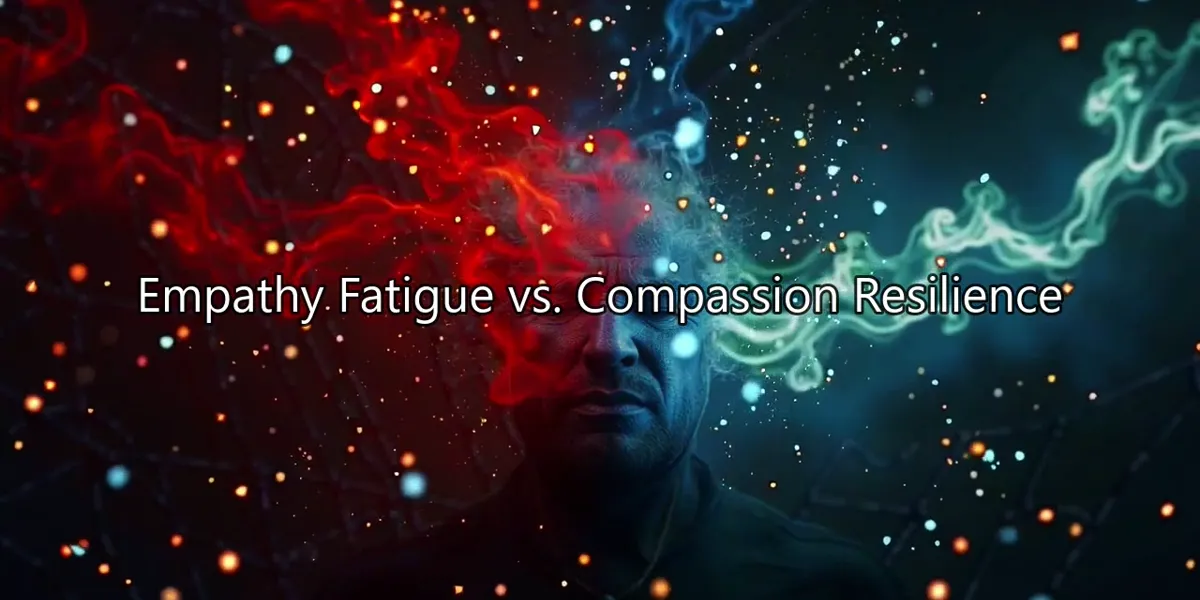
When you see someone suffering, your brain offers two distinct responses. The first is empathy — you feel what they feel. Their pain resonates in your pain circuits, their distress activates your distress. The second is compassion — you feel for them and move toward them with warmth, care, and the motivation to help. These are not the same thing, and the difference between them is one of the most important discoveries in affective neuroscience.
Tania Singer, director at the Max Planck Institute for Human Cognitive and Brain Sciences in Leipzig, demonstrated this distinction through a series of neuroimaging studies beginning in the early 2010s. When trained in empathic resonance — tuning into another’s suffering — participants showed activation in the anterior insula and anterior cingulate cortex, the same regions that activate during personal pain. They reported distress, overwhelm, and negative affect. Over time, this pattern leads to burnout.
When the same participants were trained in compassion — generating feelings of warmth and care toward the suffering person — a completely different neural network activated: the medial orbitofrontal cortex, ventral striatum, and areas associated with affiliation, reward, and positive affect. They reported feeling warm, connected, and motivated. Over time, this pattern leads to resilience.
Singer’s ReSource Project, a large-scale longitudinal training study, confirmed that these two responses can be independently trained. Empathy training without compassion leads to empathy fatigue. Compassion training builds a buffer against it. The practical implication for healers, caregivers, and anyone who works with suffering is direct: you don’t need less empathy. You need more compassion.
Self-Compassion: The Foundation
Kristin Neff, a psychologist at the University of Texas at Austin, brought the concept of self-compassion into Western psychology with her 2003 article in Self and Identity and her 2011 book Self-Compassion: The Proven Power of Being Kind to Yourself. Her framework identifies three components:
Self-kindness vs. self-judgment — Meeting your own suffering with warmth rather than harsh criticism. When you fail, instead of “I’m an idiot,” the self-compassionate response is “this is a moment of difficulty, and I’m going to treat myself with the same care I’d offer a friend.”
Common humanity vs. isolation — Recognizing that suffering and imperfection are part of the shared human experience, not evidence of personal deficiency. “Everyone struggles. Everyone fails. I am not alone in this.”
Mindfulness vs. over-identification — Holding painful experiences in balanced awareness rather than either suppressing them or being swept away by them. You notice the suffering without drowning in it.
The research consistently shows that self-compassion predicts lower anxiety, depression, and rumination, and higher well-being, emotional resilience, and motivation. Critically, self-compassion does not reduce motivation or standards — a common fear. Self-compassionate people are actually more likely to try again after failure because they don’t waste energy on self-punishment.
Loving-Kindness Meditation: The Research
Metta meditation — the systematic cultivation of loving-kindness toward self and others — has been practiced in Buddhist traditions for over 2,500 years. The Western research on its effects has accumulated rapidly since the early 2000s.
Barbara Fredrickson’s landmark 2008 study found that participants who practiced loving-kindness meditation for seven weeks showed increases in positive emotions that built personal resources — improved mindfulness, greater sense of purpose, better social support, fewer illness symptoms — which in turn predicted increased life satisfaction.
Most strikingly, loving-kindness meditation increased vagal tone — the activity of the vagus nerve, a key index of cardiac health and emotional regulation. The heart, quite literally, became more responsive to connection.
Cendri Hutcherson, Emma Seppala, and James Gross at Stanford showed that just seven minutes of loving-kindness meditation increased feelings of social connection and positivity toward strangers. The bar for entry is astonishingly low.
Compassion-Focused Therapy: The Three Systems
Paul Gilbert developed Compassion-Focused Therapy specifically for people with high levels of shame and self-criticism. His model identifies three emotional regulation systems:
The Threat System — Detects danger, activates fight-flight-freeze. Mediated by the amygdala and sympathetic nervous system. Designed to dominate the others when activated — survival comes first.
The Drive System — Pursues resources, achievement, and status. Mediated by dopamine circuits. Can become compulsive.
The Soothing/Affiliative System — Activated by connection, warmth, and safety. Generates contentment, calm, and trust. Mediated by oxytocin, endorphins, and the vagus nerve.
Gilbert’s key insight: many psychologically distressed people have an overdeveloped threat system, a hyperactive drive system, and a profoundly underdeveloped soothing system. They may have never experienced consistent warmth — and so the neural infrastructure for self-soothing was never properly built. You cannot think your way to feeling safe. You must practice feeling safe, over and over, until the neural circuits thicken.
The Dalai Lama-Davidson Collaboration
During compassion meditation, long-term Tibetan Buddhist monks generated gamma wave oscillations 25-30 times greater than novice meditators — a power and coherence never before recorded in the neuroscience literature. Structurally, the monks showed increased gray matter in regions associated with emotion regulation, empathy, and attention.
Davidson’s work provided some of the first hard evidence that contemplative training produces measurable, lasting changes in brain structure and function — not just during meditation but at baseline.
Compassion as Evolutionary Advantage
Dacher Keltner argues that compassion, awe, and gratitude are not soft luxuries evolved on top of a fundamentally selfish nature. They are central adaptations that enabled human survival through cooperation, caregiving, and group cohesion.
Darwin himself wrote more about love, sympathy, and moral emotions than about competition in The Descent of Man. The “survival of the fittest” narrative — popularized by Herbert Spencer, not Darwin — drastically oversimplifies evolutionary dynamics. In social species, the “fittest” individual is often the most cooperative, not the most aggressive.
Compassion is not weakness. It is a biological capacity refined over millions of years of mammalian evolution, designed to enable exactly the kind of cooperative care that distinguishes thriving communities from mere survival. To train it deliberately is not to override human nature. It is to fulfill it.
When you encounter your own suffering today — the small frustration, the familiar shame, the old grief — can you meet it not as an enemy to defeat but as a guest who has traveled a long way to find you?